
By Staff Writer, Mellisa Strong
November 29, 2025
THE “CIVIL RIGHTS COMPLIANCE BREAKTHROUGH” SHAKING UP CALIFORNIA SECURITY RANKS
In today’s political climate, the phrase “Civil Rights Compliance Breakthrough” has become more than a slogan. It is emerging as a defining benchmark in the accountability movement sweeping across state agencies, private companies, and frontline security forces. A newly issued certificate from the California Civil Rights Department—awarded to Investigator K. Faler—has sparked fresh debate, renewed questions, and energized conversations about training integrity and government oversight.
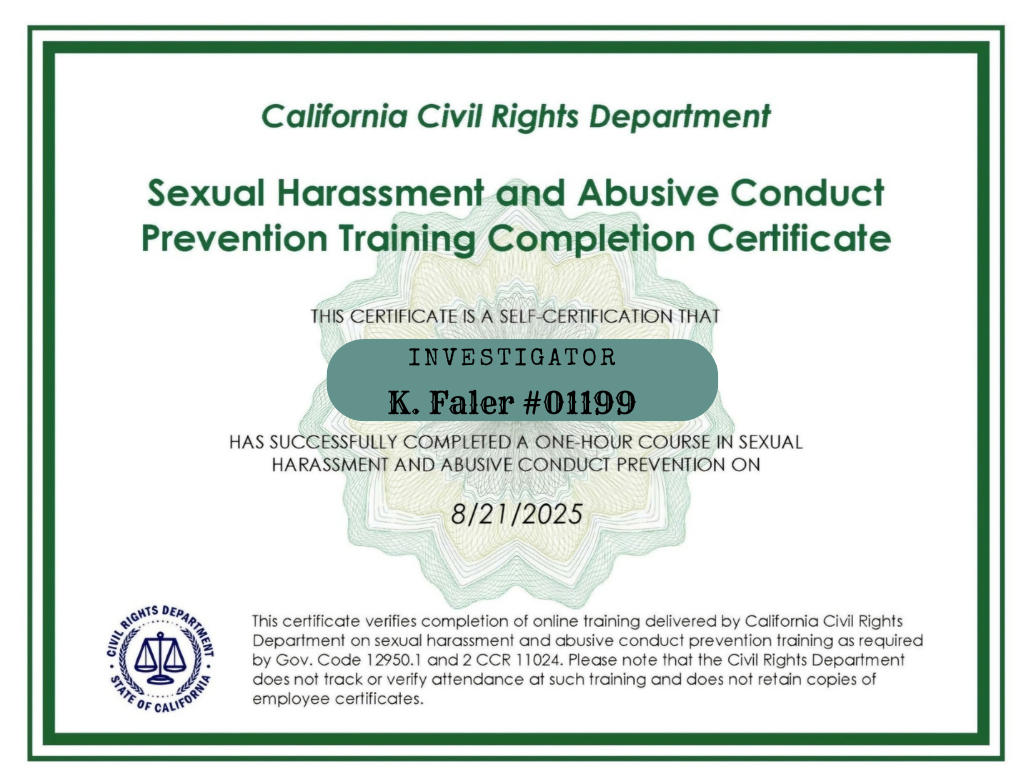
The document, confirming completion of state-mandated sexual harassment and abusive conduct prevention training, provides more than a credential. It represents visible evidence of mandatory compliance in a system that often leaves taxpayers wondering whether leadership is enforcing standards or simply checking boxes. This Civil Rights Compliance Breakthrough is pushing the conversation forward, amplifying demands for transparency in California’s most sensitive public-facing industries.
A CIVIL RIGHTS COMPLIANCE BREAKTHROUGH THAT RAISES NEW EXPECTATIONS
The certificate, dated August 21, 2025, stands as a reminder that California’s Civil Rights Department is attempting to demonstrate its commitment to employee accountability. Investigator K. Faler’s validated completion offers proof that at least one professional inside California’s widening web of experts is taking the training seriously. Many Californians believe this marks a shift in attitude, a growing consciousness about conduct expectations.
Yet, this Civil Rights Compliance Breakthrough arrives at a time when suspicion remains high. Many California residents feel the state continues to struggle with institutional inconsistency. Some employees follow the rules. Others appear insulated from responsibility. People are tired of mixed standards. When a certificate like this surfaces, the public pays attention.
It is not just a piece of paper. It symbolizes the broader movement toward demanding professionalism from those empowered to enforce or investigate workplace conduct.
WHY A SINGLE CERTIFICATE MATTERS IN TODAY’S CULTURE WAR LANDSCAPE
This moment highlights why documentation of this kind is gaining significance. California has positioned itself as a state obsessed with policy messaging. Ordinary citizens, however, often experience something entirely different: bureaucratic confusion, slow response times, and contradictory enforcement. Because of this, a legitimate record of completed training becomes a small victory. It demonstrates one clear example of expectations met, obligations honored, and education received.
The Civil Rights Compliance Breakthrough narrative underscores how rare transparency has become. People want accountability that is visible. They want evidence that someone, somewhere, is actually following through on mandated policies. This certificate now serves as a reference point. It shows that compliance can be achieved when individuals treat requirements with seriousness.
Critics argue that California’s Civil Rights Department has long allowed self-certification to replace real oversight. Supporters point to employees like Investigator Faler as proof of dedication within the system. Both perspectives matter. These conversations must continue. Political tensions surrounding training standards are only increasing.
TRAINING IS MORE THAN A REQUIREMENT—IT IS A REFLECTION OF PUBLIC TRUST
The sexual harassment and abusive conduct prevention training addressed in the certificate is not political theater. It is a safeguard. The public depends on trained personnel to understand boundaries, respect rights, and identify abusive patterns. The state’s updated directives, including those tied to Gov. Code 12950.1 and 2 CCR 11024, aim to produce competent professionals ready to navigate volatile workplace conflicts.
This Civil Rights Compliance Breakthrough serves as a staged moment where policy intersects with real-world expectations. People want investigations handled with fairness. They want misconduct addressed quickly. They want real action, not repeated announcements. When an investigator receives certification, it fulfills a basic trust obligation. It signals that at least the foundational training is in place.
Still, skeptics note the glaring language on the certificate: the Civil Rights Department does not track attendance or retain records of employee certificates. That raises valid concerns. If compliance cannot be verified, is the breakthrough merely symbolic? Or does it mark the beginning of a demanded cultural correction?
THE SECURITY SECTOR FEELS THE IMPACT OF THIS COMPLIANCE SHIFT
Security officers, investigators, and private enforcement personnel often find themselves on the frontline of public interactions. California’s private security industry has ballooned in recent years, and its workforce increasingly handles sensitive, high-tension environments. The Civil Rights Compliance Breakthrough represented in Investigator Faler’s certification could influence how security companies approach training requirements.
As professionalism expectations rise, California residents will likely demand more documented accountability from these industries. They want assurances that the individuals interacting with vulnerable people understand the boundaries of power. Many believe this certificate symbolizes a new moment in security oversight—one where transparency becomes standard rather than optional.
PUBLIC RESPONSE AND THE GROWING PUSH FOR VERIFIED ACCOUNTABILITY
The public is watching. Citizens are asking whether state departments are willing to modernize their tracking methods. People want reliable verification systems that guarantee employee training records are real and accessible. Without those, the trust gap widens.
This Civil Rights Compliance Breakthrough should inspire further reform. Californians deserve strong verification, not disclaimers that records are not retained. Accountability only works when documentation can be confirmed.
Support for reform is growing. Many call for digital tracking. Others demand legislative updates. Investigators, officers, and supervisors all benefit from clear systems. The certificate shared in this report is a snapshot of what compliance can look like. It should encourage deeper ambition for California’s civil rights infrastructure.
A CALL TO ACTION FOR READERS AND CALIFORNIA RESIDENTS
Readers are encouraged to reflect on the importance of documentation and oversight. Training is vital. Transparency is essential. If California wishes to restore public confidence, it must embrace the spirit of this Civil Rights Compliance Breakthrough and expand it. Demand honesty. Demand accessible verification. Demand consistent accountability.
Your voice matters. Engage with local leaders. Ask questions. Challenge weak systems. Share concerns. The public has the power to drive reform, and thoughtful citizens can make a difference with steady pressure.
For commentary, insights, or to share information about workplace conduct issues, reach out to info@kevinfaler.com. Your feedback fuels our reporting. Together, we push for more accountability and stronger enforcement across the state.
The future of California’s investigative integrity may depend on whether this Civil Rights Compliance Breakthrough becomes the rule—or remains the rare exception.